hledger-ui
NAME
hledger-ui - terminal interface (TUI) for hledger, a robust, friendly
plain text accounting app.
SYNOPSIS
hledger-ui [OPTS] [QUERYARGS]
orhledger ui [OPTS] [QUERYARGS]
DESCRIPTION
This manual is for hledger's terminal interface, version 1.99. See also the hledger manual for common concepts and file formats.
hledger is a robust, user-friendly, cross-platform set of programs for tracking money, time, or any other commodity, using double-entry accounting and a simple, editable file format. hledger is inspired by and largely compatible with ledger(1), and largely interconvertible with beancount(1).
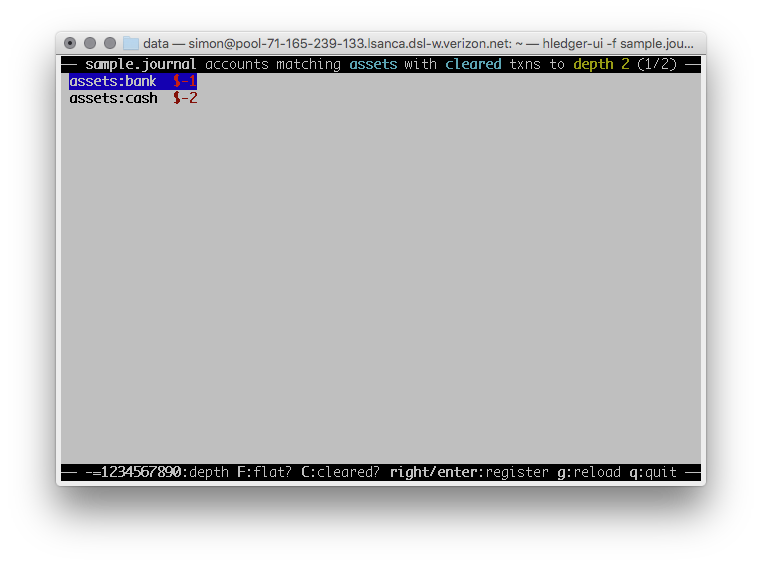
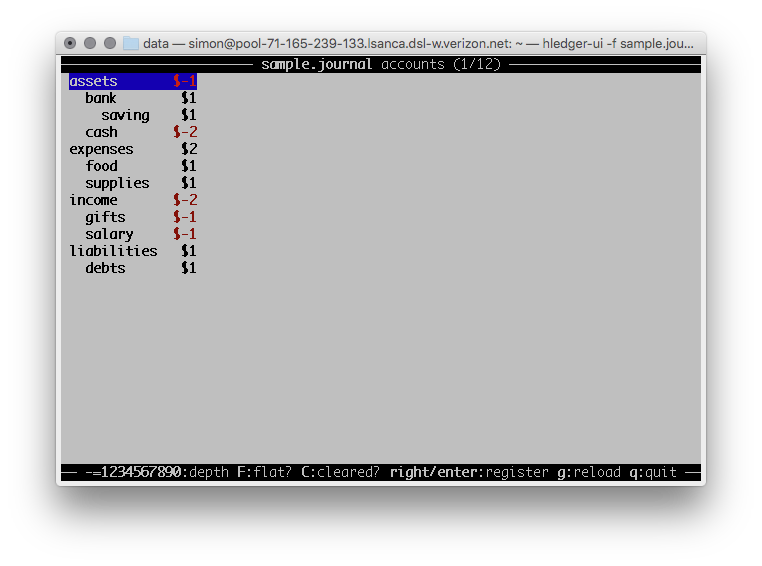
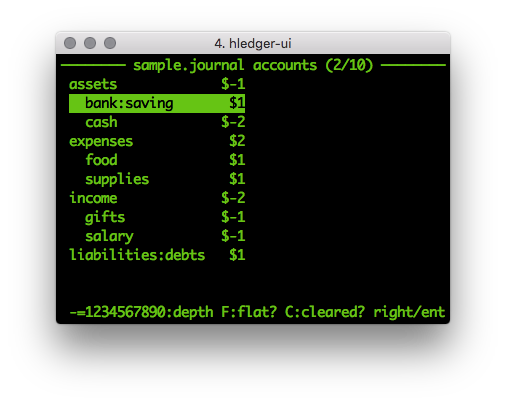
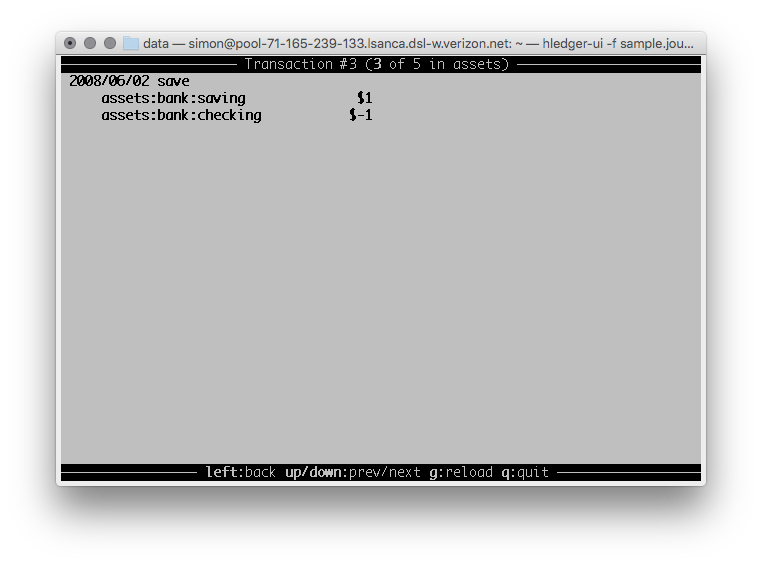
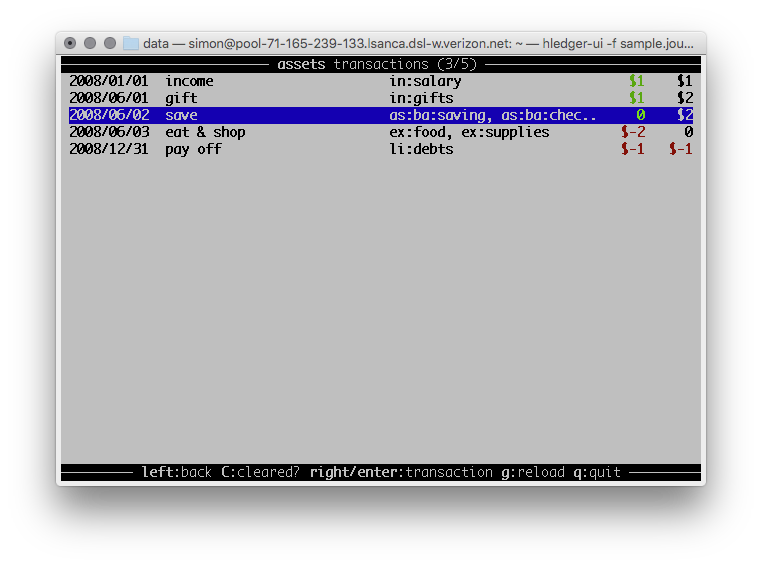
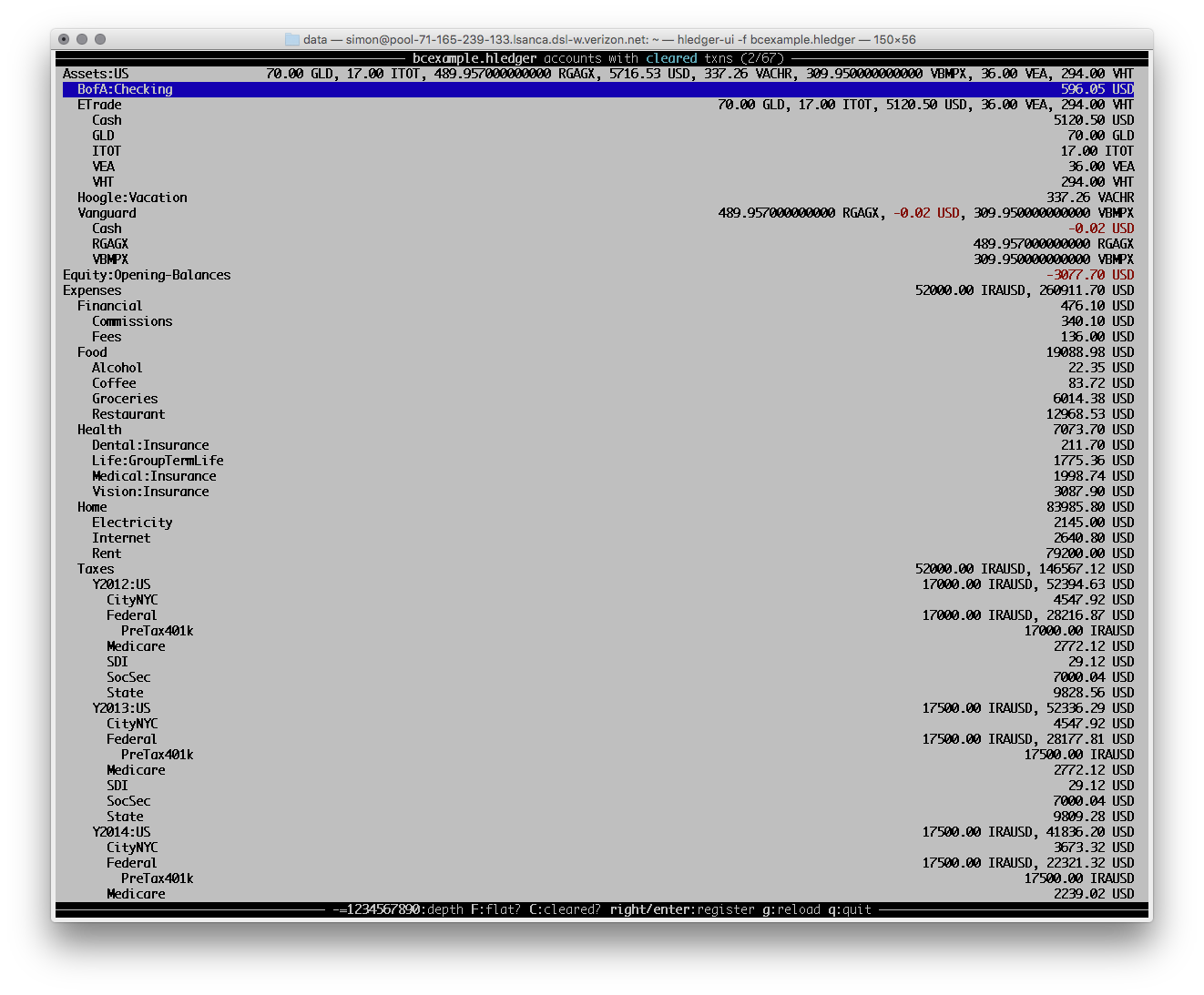
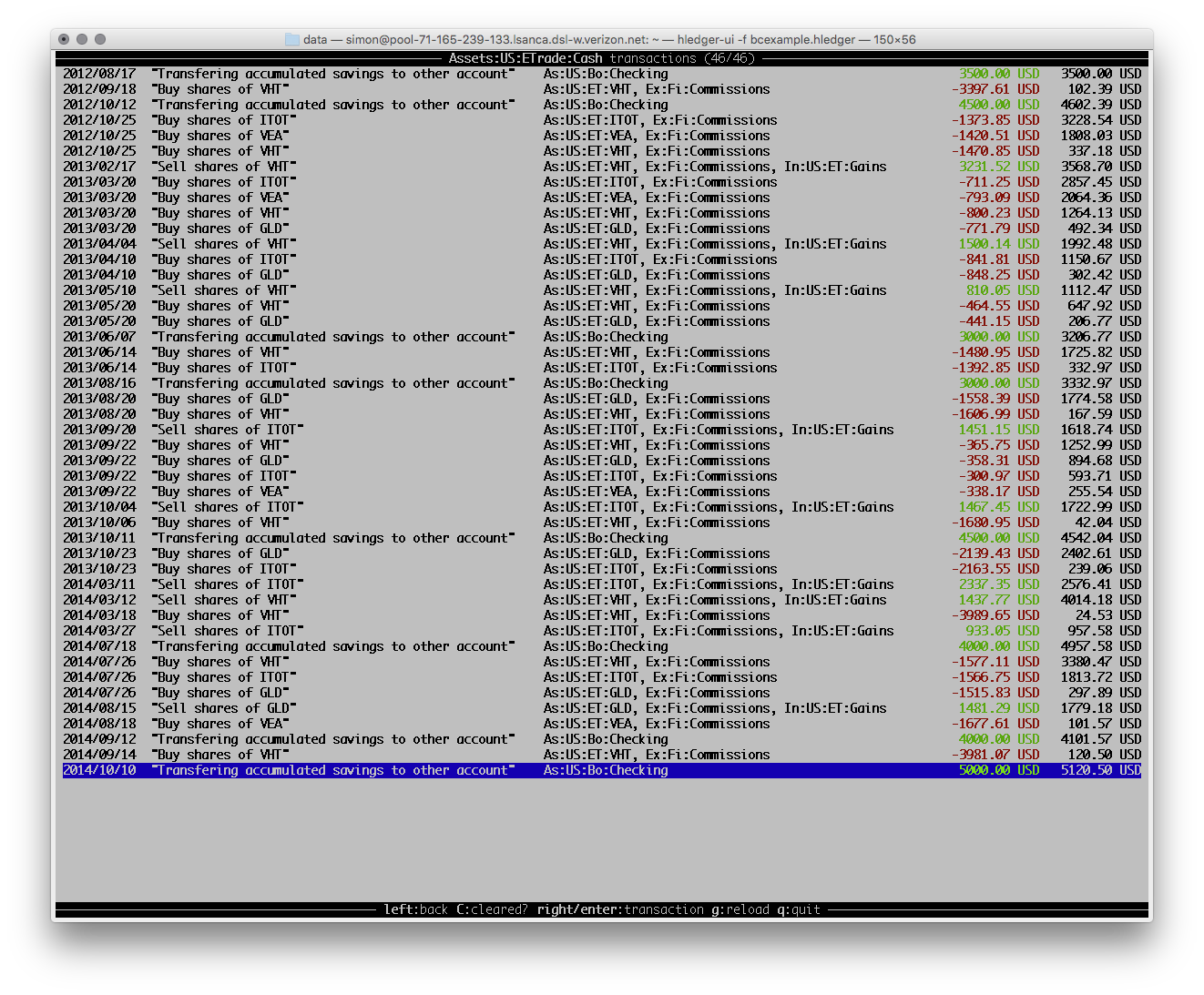
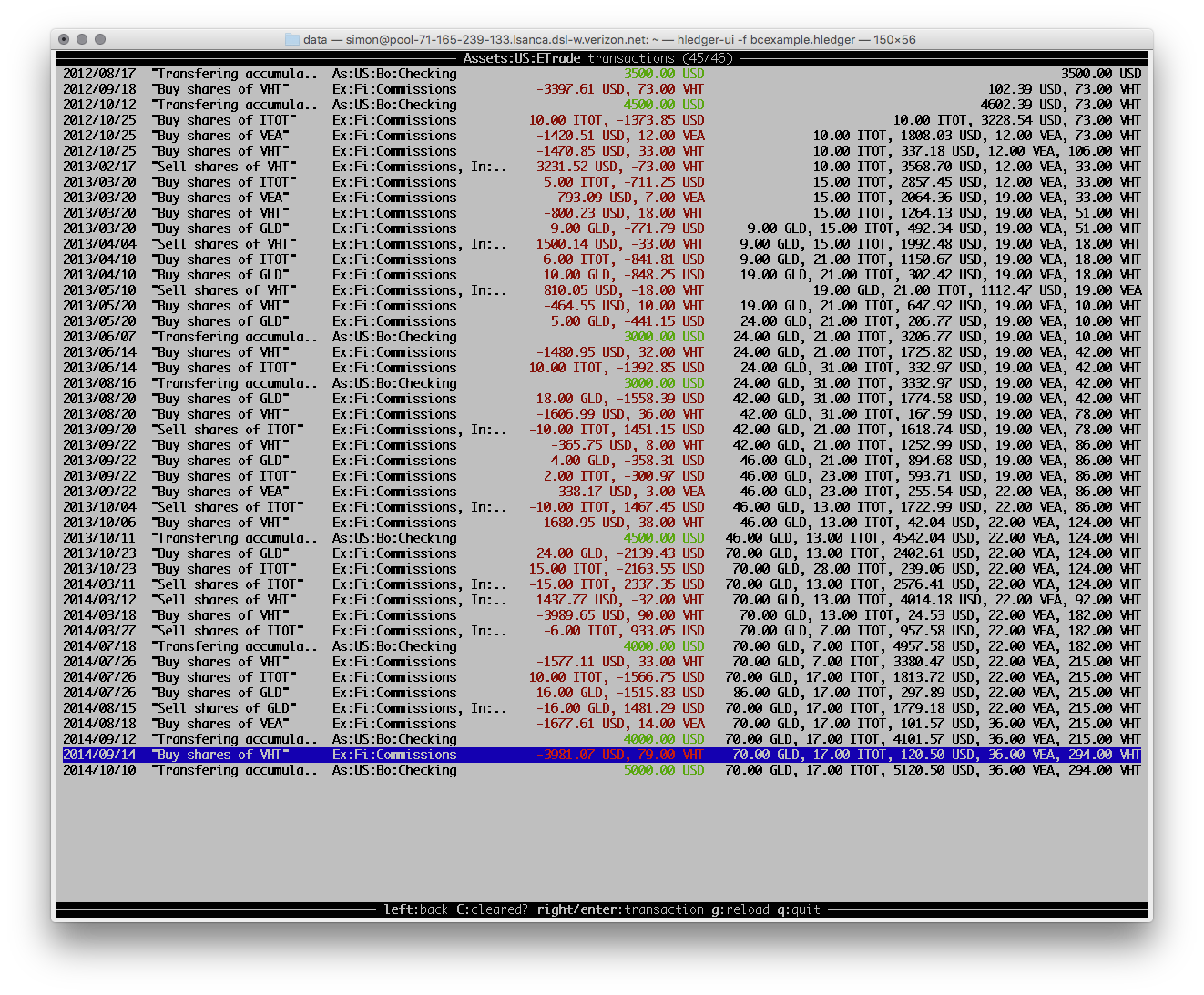
hledger-ui is hledger's terminal interface, providing an efficient full-window text UI for viewing accounts and transactions, and some limited data entry capability. It is easier than hledger's command-line interface, and sometimes quicker and more convenient than the web interface.
Like hledger, it reads from (and appends to) a journal file specified by
the LEDGER_FILE environment variable (defaulting to
$HOME/.hledger.journal); or you can specify files with -f options.
It can also read timeclock files, timedot files, or any CSV/SSV/TSV file
with a date field. (See hledger(1) -> Input for details.)
On unix-like systems, it can also read from standard input (-f-). In
that case the data can't be re-read or edited, so the g, a, A and
E keys and watch mode have no effect.
Unlike hledger, hledger-ui hides all future-dated transactions by default. They can be revealed, along with any rule-generated periodic transactions, by pressing the F key (or starting with --forecast) to enable "forecast mode".
OPTIONS
Any arguments are interpreted as a hledger query which filters the data. hledger-ui provides the following options:
Flags:
  -w --watch                watch for data and date changes and reload
                            automatically (default)
     --no-watch             don't watch; reload only with the g key
     --theme=THEME          use this custom display theme (light,
                            dark, terminal, greenterm)
     --cash                 start in the cash accounts screen
     --bs                   start in the balance sheet accounts screen
     --is                   start in the income statement accounts screen
     --all                  start in the all accounts screen
     --register=ACCTREGEX   start in the (first matched) account's register
     --change               show period balances (changes) at startup instead
                            of historical balances
  -l --flat                 show accounts as a flat list (default)
  -t --tree                 show accounts as a tree
hledger-ui also supports many of hledger's general options:
General input flags:
  -f --file=[FMT:]FILE      Use this as the journal file (- means stdin). If
                            not specified, $LEDGER_FILE or ~/.hledger.journal
                            will be used. If specified more than once, the
                            files will be read in order. Each file's format
                            (journal, csv, timeclock, timedot, rules..) is
                            inferred from the file extension or a FMT: prefix.
                            Some commands (add, import) write to the (first)
                            file, and expect it to be in journal format.
     --rules=RULESFILE      Use rules defined in this rules file for
                            converting subsequent CSV/SSV/TSV files. If not
                            specified, uses FILE.csv.rules for each FILE.csv.
     --alias=A=B|/RGX/=RPL  transform account names from A to B, or by
                            replacing regular expression matches
     --auto                 generate extra postings by applying auto posting
                            rules ("=") to all transactions
     --forecast[=PERIOD]    Generate extra transactions from periodic rules
                            ("~"), from after the latest ordinary transaction
                            until 6 months from now. Or, during the specified
                            PERIOD (the equals is required). Auto posting rules
                            will also be applied to these transactions. In
                            hledger-ui, also make future-dated transactions
                            visible at startup.
     --ignore-assertions    don't check balance assertions by default
     --ignore-lots          don't do lot tracking or checking by default
  -I                        shortcut for --ignore-assertions --ignore-lots
     --txn-tolerance=...    how much imbalance to allow in transactions:
                            'entry':   - the entry's precision (default)
                            'display': - display precision (legacy)
     --infer-costs          infer costs from conversion equity postings
     --infer-equity         infer conversion equity postings from costs
     --infer-imbalance      add postings showing tolerated imbalances
     --infer-market-prices  infer market prices from costs
     --pivot=TAGNAME        use a different field or tag as account names
  -s --strict               do extra error checks (and override -I)

General output flags (affecting some commands):
  -b --begin=DATE           include postings/transactions on/after this date
  -e --end=DATE             include postings/transactions before this date
                            (with a report interval, will be adjusted to
                            following subperiod end)
  -D --daily                set report interval: 1 day
  -W --weekly               set report interval: 1 week
  -M --monthly              set report interval: 1 month
  -Q --quarterly            set report interval: 1 quarter
  -Y --yearly               set report interval: 1 year
  -p --period=PERIODEXP     set begin date, end date, and/or report interval,
                            with more flexibility
     --today=DATE           override today's date (affects relative dates)
     --date2                match/use secondary dates instead (deprecated)
  -U --unmarked             include only unmarked postings/transactions
  -P --pending              include only pending postings/transactions
  -C --cleared              include only cleared postings/transactions
                            (-U/-P/-C can be combined)
  -R --real                 include only non-virtual postings
  -E --empty                Show zero items, which are normally hidden.
                            In hledger-ui & hledger-web, do the opposite.
     --depth=DEPTHEXP       if a number (or -NUM): show only top NUM levels
                            of accounts. If REGEXP=NUM, only apply limiting to
                            accounts matching the regular expression.
  -B --cost                 convert amounts to their cost basis ({}), or else
                            their cost/sale amount (@/@@)
  -V --market               valuation mode: show amounts converted to market
                            value at period end(s) in their default valuation
                            commodity. Short for --value=end.
  -X --exchange=COMM        valuation mode: show amounts converted to market
                            value at period end(s) in the specified commodity.
                            Short for --value=end,COMM.
     --value=WHEN[,COMM]    valuation mode: show amounts converted to market
                            value on the specified date(s) in their default
                            valuation commodity or a specified commodity. WHEN
                            can be:
                            'then':     value on transaction dates
                            'end':      value at period end(s)
                            'now':      value today
                            YYYY-MM-DD: value on given date
                            'cost':     cost basis, or else transacted cost
                            (same as -B)
                            'transacted': transacted cost/sale amount (@/@@)
                            only
     --lots                 show lot subaccounts and other lot details
  -c --commodity-style=S    Override a commodity's display style.
                            Eg: -c '.' or -c '1.000,00 EUR'
     --pretty[=YN]          Use box-drawing characters in text output? The
                            optional 'y'/'yes' or 'n'/'no' arg requires =.
     --title=T              set or customise a report title
     --subreport-titles=TS  customise subreport headings in compound reports
                            (|-separated)
     --period-titles=OPT    customise headings in periodic reports:
                            'compact': readable period names when possible
                            'dates':   exact dates/date ranges always

General help flags:
  -?                        show the hledger quick reference
  -h --help                 show this command's usage help
     --info                 show this command's manual with info
     --man                  show this command's manual with man
     --webman               show this command's manual on the web
     --examples             show examples for this command
     --version              show version information
     --debug=[1-9]          show this much debug output (default: 1)
     --pager=YN             use a pager when needed ? y/yes (default) or n/no
     --color=YNA --colour   use ANSI color ? y/yes, n/no, or auto (default)
     --lang=LANG            language for the user interface:
                            en (default), de, zh, or auto
With hledger-ui, the --debug option sends debug output to a
hledger-ui.log file in the current directory.
If you use the bash shell, you can auto-complete flags by pressing TAB in the command line. If this is not working see Install > Shell completions.
MOUSE
In most modern terminals, you can navigate through the screens with a mouse or touchpad:
- Use mouse wheel or trackpad to scroll up and down
- Click on list items to go deeper
- Click on the left margin (column 0) to go back.
KEYS
Keyboard gives more control. ? shows a help dialog listing all keys.
(Some of these also appear in the quick help at the bottom of each
screen.) Press ? again (or ESCAPE, or LEFT, or q) to close it.
While it is open, p, m or i show this manual in a pager, man or
info.
The following keys work on most screens. Additional screen-specific keys are described under SCREENS below.
Navigation keys
The cursor keys navigate: RIGHT or ENTER goes deeper, LEFT returns
to the previous screen, UP/DOWN/PGUP/PGDN/HOME/END move up
and down through lists. J/K jump down/up 10 items at a time.
Emacs-style (CTRL-p/CTRL-n/CTRL-f/CTRL-b) and VI-style
(k,j,l,h) movement keys are also supported.
(Tip: movement speed is limited by your keyboard repeat rate, to move faster you may want to adjust it. On a mac, the Karabiner app is one way to do that.)
ESCAPE resets the UI state and jumps back to the top screen, restoring
the app's initial state at startup. Or, it cancels minibuffer data
entry or the help dialog.
CTRL-l redraws the screen and centers the selection if possible
(selections near the top won't be centered, since we don't scroll
above the top).
Filtering keys
/ lets you set a general filter query limiting the data shown, using
the same query terms as in hledger and
hledger-web. While editing the query, you can use CTRL-a/e/d/k, BS,
cursor
keys;
press ENTER to set it, or ESCAPE to cancel. There are also keys for
quickly adjusting some common filters like account depth and transaction
status (see below). BACKSPACE or DELETE removes all filters, showing
all transactions.
As mentioned above, by default hledger-ui hides future transactions -
both ordinary transactions recorded in the journal, and periodic
transactions generated by rule. F toggles forecast mode, in which
future/forecasted transactions are shown.
Pressing SHIFT-DOWN narrows the report period, and pressing SHIFT-UP
expands it again. When narrowed, the current report period is displayed
in the header line, pressing SHIFT-LEFT or SHIFT-RIGHT moves to the
previous or next period, and pressing T sets the period to "today".
If you are in watch mode (the default) and viewing a narrowed period
containing today, the view will follow any changes in system date
(moving to the period containing the new date). (These keys work only
with standard calendar year/quarter/month/week/day periods; they are not
affected by a custom report interval specified at the command line.)
You can also specify a non-standard period with / and a date: query;
in this case, the period is not movable with the arrow keys.
(Tip: shifted arrow keys don't work out of the box in all terminals. In
Apple's Terminal, SHIFT-DOWN and SHIFT-UP must be added in Preferences
> Profiles > Keyboard, sending \033[1;2B and \033[1;2A
respectively. Other terminals may need SHIFT-RIGHT and SHIFT-LEFT
configured to send \033[1;2C and \033[1;2D.)
Other keys
g reloads from the data file(s) and updates the current screen and any
previous screens. (With large files, this could cause a noticeable
pause.)
I toggles balance assertion checking. Disabling balance assertions
temporarily can be useful for troubleshooting. (If hledger-ui was
started with a --pivot option, re-enabling balance assertions with the
I key also reloads the journal, like g.)
a runs command-line hledger's add command, and reloads the updated
file. This allows some basic data entry.
A is like a, but runs the
hledger-iadd tool,
which provides a terminal interface. This key will be available if
hledger-iadd is installed in $PATH.
E runs $HLEDGER_UI_EDITOR, or $EDITOR, or a default
(emacsclient -a "" -nw, or notepad.exe on Windows) on the journal
file. With some editors, the cursor will be positioned at the current
transaction when invoked from the register and transaction screens, and
at the error location (if possible) when invoked from the error screen.
B toggles cost mode, showing amounts converted to their cost's
commodity (see hledger manual > Cost
reporting).
V toggles value mode, showing amounts converted to their market value
(see hledger manual > Value reporting).
More specifically,
-
By default, the
Vkey toggles showing end value (--value=end) on or off. The valuation date will be the report end date if specified, otherwise today. -
If you started hledger-ui with some other valuation (such as
--value=then,EUR), theVkey toggles that off or on.
Cost/value tips: - When showing end value, you can change the report end
date without restarting, by pressing / and adding a query like
date:..YYYY-MM-DD. - Either cost mode, or value mode, can be active,
but not both at once. Cost mode takes precedence. - There's not yet any
visual indicator that cost or value mode is active, other than the
amount values.
L toggles lot detail (like the --lots flag), showing or hiding lot
subaccounts (such as assets:broker:{2026-01-15, $50}) and other
per-lot detail.
q quits the application.
CTRL-z suspends it, returning to the shell; resume it with fg as
usual.
SCREENS
At startup, hledger-ui shows a menu screen by default. From here you can
navigate to other screens using the cursor keys: UP/DOWN to select,
RIGHT to move to the selected screen, LEFT to return to the previous
screen. Or you can use ESC to return directly to the top menu screen.
You can also use a command line flag to specify a different startup
screen (--cash, --bs, --is, --all, or --register=ACCT).
On the four accounts screens, t toggles between tree mode and list
mode, and you can limit the account depth shown: 1 to 9 set the
depth limit, 0 sets it to zero (showing just a single total), and -
and + (or _ and =) decrease and increase it. DELETE resets it,
along with any other filters.
Menu screen
This is the top-most screen. From here you can navigate to several screens listing accounts of various types. Note some of these may not show anything until you have configured account types.
Cash accounts screen
This screen shows "cash" (ie, liquid asset) accounts (like
hledger balancesheet type:c). It always shows balances (historical
ending balances on the date shown in the title line).
Balance sheet accounts screen
This screen shows asset, liability and equity accounts (like
hledger balancesheetequity). It always shows balances.
Income statement accounts screen
This screen shows revenue and expense accounts (like
hledger incomestatement). It always shows changes (balance changes in
the period shown in the title line).
All accounts screen
This screen shows all accounts in your journal (unless filtered by a
query; like hledger balance). It shows balances by default; you can
toggle showing changes with the H key.
Register screen
This screen shows the transactions affecting a particular account. Each line represents one transaction, and shows:
-
the other account(s) involved, in abbreviated form. (If there are both real and virtual postings, it shows only the accounts affected by real postings.)
-
the overall change to the current account's balance; positive for an inflow to this account, negative for an outflow.
-
the running total after the transaction. With the
Hkey you can toggle between- the period total, which is from just the transactions displayed
- or the historical total, which includes any undisplayed transactions before the start of the report period (and matching the filter query if any). This will be the running historical balance (what you would see on a bank's website, eg) if not disturbed by a query.
Note, this screen combines each transaction's in-period postings to a
single line item, dated with the earliest in-period transaction or
posting date (like hledger's aregister). So custom posting dates can
cause the running balance to be temporarily inaccurate. (See hledger
manual > aregister and posting
dates.)
Transactions affecting this account's subaccounts will be included in
the register if the accounts screen is in tree mode, or if it's in list
mode but this account has subaccounts which are not shown due to a depth
limit. In other words, the register always shows the transactions
contributing to the balance shown on the accounts screen. Tree mode/list
mode can be toggled with t here also.
U toggles filtering by unmarked status, showing
or hiding unmarked transactions. Similarly, P toggles pending
transactions, and C toggles cleared transactions. (By default,
transactions with all statuses are shown; if you activate one or two
status filters, only those transactions are shown; and if you activate
all three, the filter is removed.)
R toggles real mode, in which virtual
postings are ignored.
z toggles nonzero mode, in which only transactions posting a nonzero
change are shown (hledger-ui shows zero items by default, unlike
command-line hledger).
Press RIGHT to view the selected transaction in detail.
Transaction screen
This screen shows a single transaction, as a general journal entry, similar to hledger's print command and journal format.
The transaction's date(s) and any cleared flag, transaction code, description, comments, along with all of its account postings are shown. Simple transactions have two postings, but there can be more (or in certain cases, fewer).
UP and DOWN will step through all transactions listed in the
previous account register screen. In the title bar, the numbers in
parentheses show your position within that account register. They will
vary depending on which account register you came from (remember most
transactions appear in multiple account registers). The #N number
preceding them is the transaction's position within the complete
unfiltered journal, which is a more stable id (at least until the next
reload).
On this screen (and the register screen), the E key will open your
text editor with the cursor positioned at the current transaction if
possible.
Error screen
This screen will appear if there is a problem, such as a parse error, when you press g to reload. Once you have fixed the problem, press g again to reload and resume normal operation. (Or, you can press escape to cancel the reload attempt.)
Non-fatal warnings, eg from reading CSV files, don't interrupt like this; instead they are shown on the bottom line of the screen, at startup or after a reload, until the next key press.
WATCH MODE
hledger-ui immediately shows the effect of any file changes, reloading automatically. (This is enabled by default since 1.99.5.)
If you don't want this - eg because your data is very large or
constantly changing, or because file notifications don't work well on
your system - you can disable it with --no-watch, and reload manually
with the g key instead.
Watch mode is very useful when reconciling. A good workflow is to have your bank's online register open in a browser window, for reference; the journal file open in an editor window; and hledger-ui in a terminal window, eg:
$ hledger-ui --register checking -C
As you mark things cleared in the editor, you can see the effect immediately without having to context switch. This leaves more mental bandwidth for your accounting. Of course you can still interact with hledger-ui when needed, eg to toggle cleared mode, or to explore the history.
ENVIRONMENT
LEDGER_FILE The main journal file to use when not specified with
-f/--file. Default: $HOME/.hledger.journal.
HLEDGER_UI_EDITOR, EDITOR The editor command run by the E key,
in that order of preference. Default: emacsclient -a "" -nw, or
notepad.exe on Windows.
BUGS
We welcome bug reports in the hledger issue tracker (https://bugs.hledger.org), or on the hledger chat or mail list (https://hledger.org/support).
Some known issues:
If reloading large files on a slow computer, there could be a noticeable pause, during which the UI is unresponsive.